Saturday, July 09, 2011

Rain, rain go away…


….but if it doesn’t, there are always books. Since DH’s mother went home on Tuesday morning, we haven’t had a day without rain, often rather a lot of rain, so the garden is still far too sodden for me to work outside. Of course there is always knitting to do and Assisi to ponder, in the gaps between the usual chores and my daily French language practice of listening to the radio or reading the local paper, but wet weather is when books really come into their own for me.

We’re getting quite a good collection in our French house now, and by the time I’ve read them all I should have forgotten the earliest ones and be able to start all over again. Quite how permanent English-speaking residents of France satisfy their craving for reading matter without bankrupting themselves I’m not sure, but we manage very well for our three summer months here.

At the bottom of my just-read pile is Maxwell's Reunion by M J Trow, followed by Wild About The Boy by Dolores Gordon-Smith, an enjoyable mystery in the Agatha Christie/Margery Allingham mould. Set in 1920s Britain, its likeable hero is a mystery writer turned amateur detective and its portrayal of the period is shot through with a deep awareness of the dark shadow cast by the First World War.

About to join that pile is something quite different and I have to thank The Broad at ABroad with a View  for the recommendation. It’s Pass The Polenta by Teresa Lust and consists of a series of truly wonderful essays on food and the memories it evokes. I’ve revelled in the author’s passion for her subject and found it engaging, touching, funny and mouth-watering in turn. Definitely one to reread in the future.

Alongside that I’ve just this morning started A Letter of Mary, the third of the wonderful Mary Russell mysteries by Laurie King. Starting from the premise made in the first of the series, The Beekeeper’s Apprentice, of the unlikely, yet completely believable, encounter between an elderly Sherlock Holmes and a young woman graduate student, the books describe the growing relationship between them and the intricate cases they undertake. This is really excellent writing: densely plotted, intelligently and beautifully written, with strongly-drawn characters and a gripping atmosphere of mystery and undefined threat.

With books like that to lose myself in, I may not even notice when the sun comes out again. All I need now are your suggestions as to what to read once my pile is finished….


Image via Wylio

Thursday, July 07, 2011

A city set on a hill


A saint and his setting 
Part 1: A child grows up

On a grey, wet and windy day in Normandy, with gardening out of the question, what could be more enjoyable than to bask (at least in memory) in the hot sunshine of Italy and think back over our pilgrimage to Assisi.   Not that the sun always shines there, but as it happens I've been fortunate with the weather on all my visits, so that my indelible image of Assisi is of white or pink or golden limestone, glowing against the bluest of skies.

I’ve been fascinated by Francis, both his life and his writings, for some years now and it is this, as much as the beauty of Assisi or the warmth of the Italian sunshine, which keeps drawing me back to the place where he lived.

The sun must have shone just as often and as warmly in the Assisi of the late twelfth century.  It was there, in 1181 or 82, that a baby boy was born to Pietro Bernadone, a wealthy cloth merchant of the town, and his French wife, Pica.

Image via Wikipedia


Pietro was away on a journey to France at the time of his son’s birth and his deeply religious wife had her child baptised Giovanni, in honour of Saint John the Baptist. This didn’t please Pietro, however, and on his return he renamed his son "Francesco" the little "Frenchman", perhaps because of his wife’s nationality, or his own love of France.

The house where Francesco or Francis was born no longer exists, though traces can still be seen in the fabric of the church which was later built over his childhood home. However the cathedral of San Rufino, in whose font he was baptised, still stands proudly in upper Assisi, looking, from the outside at least, much as it must have done when baby Francis was taken there over 800 years ago.  

Chiesa Nuova  - Image via Wikipedia


San Rufino


Centuries after Francis’ death and rapid canonisation, the pious belief grew up that, like the Jesus he had spent his adult life following so closely, Francis too had been born in a stable, in his case the stable of his family home. Today, one can visit a tiny, windowless, mediaeval chapel, close to the site of his parents’ house, which legend says was created from that same stable.


Francis, cushioned by his comfortable and financially secure home, grew up to be a popular and carefree, even wild young man, much given to throwing parties for his friends and having a good time. However, the Italy in which he was growing up was politically much less secure and stable, as rapid social change undermined the feudal order.

In 1198 or 99 the people of Assisi attacked and destroyed the Roccas, the feudal castles, which in their rebuilt form still dominate Assisi.  The nobles who had lived there fled to Perugia, another hill town less than 15 miles away across the valley, and soon war broke out between Assisi and Perugia.

Francis, like many of his contemporaries, went off to fight for Assisi against her enemy. In 1202, at the age of about 20, he was captured and spent a year in prison in Perugia, but the experience seems not to have affected him too deeply, for, once released and back in Assisi, he continued his carefree and often expensive life. All this changed in 1204, when Francis became gravely ill and, as he slowly recovered, began for the first time to think seriously about his life.

Spoleto  -  Image via Wikipedia
The following year he left his home and his father’s business to fulfil his ambition to be a soldier and perhaps achieve knighthood. Travelling to join his lord, who was on his way to fight in the Fourth Crusade, Francis stopped at Spoleto, another ancient hill town above the Tiber valley.  Here, it is said, he saw a vision and at once turned back towards home, convinced that whatever God wanted him to do with his life, it would be in Assisi.

To be continued…

Saturday, July 02, 2011

Normal service will be resumed shortly

For the first time since I started blogging back in February, I’ve discovered that sometimes life just takes over and blogging has to take a back seat for a while.

In the three weeks since I last posted, we’ve arrived in Normandy, evicted the spiders and reminded ourselves how the wood burner works. In fact it was so cold and wet when we got here that we checked the calendar to make sure it really was mid-June and not mid-March. Since then we’ve been settling in, meeting up with friends we haven’t seen since last year and enjoying having DH’s mother staying with us for her annual visit to France

As soon as the rain stopped and things started to dry off, I also found myself expending considerable time and effort mowing the hayfield which was threatening to engulf the house. Actually, mowing the grass is one of the jobs I really enjoy here – fresh air, healthy exercise and the illusion that I’m creating a lawn out of a patch of bumpy and overgrown orchard. Meanwhile, my doughty, 87-year-old mother-in-law has been busy digging out a narrow flower border along the front wall of the house, which we have today planted out with lavender and calendula and London Pride.

Talking of orchards, I’ve also been enjoying another of my favourite occupations this week. At the local gardening club on Tuesday I was given an unexpected, but very welcome, invitation to help myself to a friend’s remaining raspberries and blackcurrants, as she’d already picked all they could possibly use.  This meant of course that I had to spend the next day turning them into jam, with the aid of my trusty, travelling jam pan. Stop laughing over there – you should know that there are some things one simply can’t leave behind for three months – especially in summer.

So nothing exciting, but all very pleasant, and absorbing enough to leave me with very little thinking time.  Assisi isn’t forgotten, but will just have to wait a little longer. Oh – and there are cherries to pick and kittens in the woodshed to watch….


Saturday, June 11, 2011

A small cottage in Normandy

Events have rather overtaken me since DD and her husband took the grandsons home last Sunday, and the thinking time I was hoping to have, to reflect properly on our pilgrimage to Assisi, has disappeared without trace. I haven’t forgotten my promise, but it will have to wait a few more days, I’m afraid. This is partly because DH and I are gearing up for our annual visit to France, to southern Manche in Normandy to be precise, close to the border with Brittany.

One fateful Sunday afternoon, at the end of the last millennium, I happened to read an article in that day’s newspaper which turned out to have seriously far-reaching consequences for DH and me. It was about the growing number of British people who were snapping up houses in rural France at bargain prices, such bargain prices that it looked like this might even be a possibility for us too. I started to daydream about holidays in France in our own little cottage, though I must admit that DH’s eyebrows were very sceptically raised at that point.

As I have described elsewhere, he tried very hard to dissuade me and even bought a tiny campervan as a substitute.  That worked for a few months, but, as it turned out, the second long trip we had in it was the following year, during a cold, wet and windy week in February.  DH had surrendered and we were on a house-hunting expedition to southern Normandy. Not only was the ferry crossing cheaper at that time of year, but we reasoned that if we liked a place under those conditions, we would love it in summer.

During that week we looked at an interesting collection of houses, some habitable, but extremely small (our budget being equally miniscule) and some not much more than four walls and a roof. Then we struck gold.

In a small market town we went into the local estate agent’s office, to say that we had changed our minds about the house he was due to show us and did he have any others within our budget. He had two, one impossible and one which we knew, as soon as we saw it, could be the one for us.

The house when we bought it (estate agent's photo)
It was small, but not too small.  It was totally unmodernised, but had recently  had a new roof, the old one having been blown off in the great storm which ravaged much of western France in December 1999.  Best of all, it sat squarely in its good-sized patch of ground and was affordable.  We knew we would have an awful lot to do to make it properly habitable, but that didn’t matter. 

After a long evening’s discussion in the campervan, we went back first thing next morning to see the estate agent and by the end of that day we had signed the compromis de vente, the promise to buy which is the first part of the French system of house purchase.

That was eight years ago and the house still isn’t finished. But it is now habitable, and since my retirement 4 years ago we have spent every summer there, among the gentle, rolling, green hills of this beautiful and deeply rural corner of France. This time next week we will be there once again, clearing away the cobwebs and chasing out the spiders, and deciding which room we’re going to tackle this summer. But it won’t be all work and I’ll have plenty of time to blog or knit or just sit and talk. Watch this space…
Summer 2010     7 years on - a work still in progress


Sunday, June 05, 2011

Beauty right under my nose

Today the grandsons went home after a really enjoyable visit (for us, and hopefully for them) and I’m now recovering with a nice pot of tea and a gentle browse through the photos we’ve taken this week. After the rain-sodden Bank Holiday weekend the weather improved rapidly and we were able to go out to show them the Mid-Wales countryside, so different from their home area in the flat plain of the southern Vale of York.

On Thursday afternoon, while I was otherwise engaged, DH took them to visit the wind-farm on the hills across the valley from us. Mid-Wales is home to an increasing number of wind-farms, and the rate of growth is proving to be more than a little controversial. For what it’s worth, DH and I don’t have a problem with this, but I realise it isn’t a view shared by everyone.

This particular wind-farm is one of the longest-established in the area, and when it was opened in 1993, it was the largest in Europe. By today’s standards, however, its output is modest and it is due to be rebuilt, but the present  turbines still managed to awe our two talkative grandsons into silence.


On  Saturday, after we had been joined by DD and her husband, we went to visit one of my favourite local beauty-spots, in the heart of the Hafren Forest.  The forest takes its name from Afon Hafren (River Severn) which rises less than a mile outside its western boundary, high on the slopes of Pumlumon, the highest mountain in Mid-Wales.

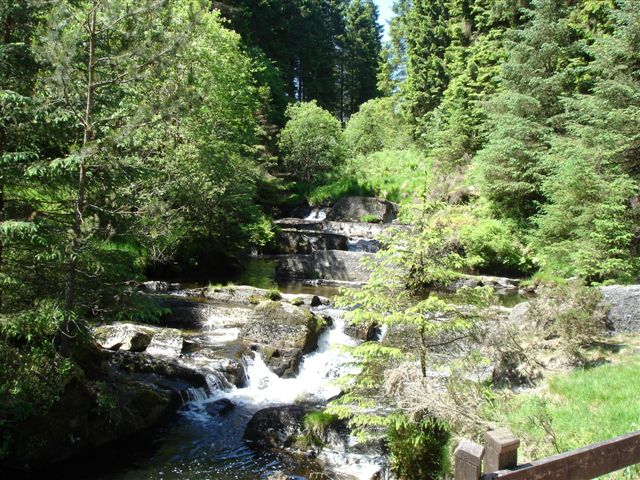
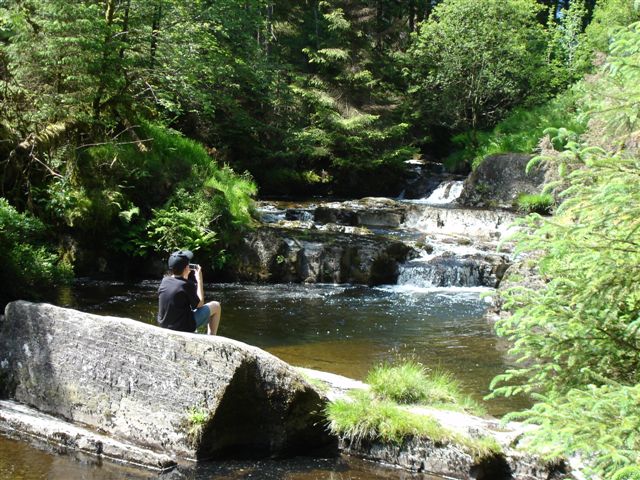
After our picnic lunch we went for a wonderful walk alongside the infant Severn, which at this point on its journey to the sea tumbles over a series of small, rocky waterfalls, known as the Cascades.

Years ago the Forestry Commission installed a board-walk along the boggy river-bank, to enable even those with limited mobility to enjoy this extraordinarily beautiful spot, as well as waymarking a series of walks through the forest to satisfy all levels of energy and fitness.


DH and I contented ourselves with a modest stroll, and while DD and her family went off for something a little more strenuous, we walked back to the boardwalk to sit by the river and contemplate the beauty to be found so very close to home.


Once I've tidied up after the visit and gathered my thoughts, I will share more of my trip to Assisi with you, but until then there is something eternally restful and constant about the ever-changing flow of a river.