Showing posts with label history. Show all posts

Tuesday, March 10, 2015

Lost in the past

It all started early last month, when I learned that the genealogical website Ancestry was offering a weekend of free access to all its records. Two of my three younger sisters have done a great deal of family history research over the past few years, but somehow the bug passed me by. I’ve been genuinely interested in their discoveries and have used some of their information in previous posts, but I never felt the need to do the research myself - until now.

The Ancestry weekend whetted my appetite and since then I’ve enjoyed starting to put together my own version of our family tree.  However, last weekend moved things onto a whole new level. This is because another family history website was offering three whole days of free access to their huge stock of worldwide records  and this time DH was away visiting his mother and I had almost the entire weekend to myself.

Over the previous few weeks I had learned enough to know exactly what to look for this time. In three packed days I experienced the most enormous enjoyment and satisfaction as I gradually put flesh on the bones of my skeleton family tree (if you’ll excuse the mixed metaphor) and fitted half-forgotten names from my childhood into their proper places. Without DH to remind me about mealtimes I even forgot to have breakfast one day and ended up eating my cereal for lunch!

By the time the free access period ended I’d amassed an enormous amount of information, which I now have to organise and make sense of. But in addition to information I’ve gained something else over the past few days – something perhaps more important than factual details and certainly more personal.

Scanning through census returns, searching birth, marriage and death records, and adding details to the family tree, has brought the lives and backgrounds of my ancestors and their wider family members into very sharp focus, Suddenly I find myself trying to put myself into the shoes of two of my great-great-grandmothers, one of whom gave birth to at least thirteen live children and saw four die in infancy. Even more tragically, the other also had thirteen children, of whom only seven survived into adulthood.

My great-uncle George as he started school in 1896

The streets teemed with children, including three of my great-uncles.

Both these great-great-grandmothers lived in the industrial Lancashire town where I was born and I know the streets of small terraced houses in which they struggled to feed and clothe their large families.  One was the wife of a brick and tile maker, the other of a cotton weaver, so money must have often been very scarce with so many children to care for.

My great-grandfather, aged two, and seven of his siblings on the 1871 census

No wonder then that as soon as the children reached the school leaving age of 13, they too found themselves in the brickworks or the cotton mill, working long hours and bringing their wages home to swell the family purse. They usually went on living at home until they married and even then rarely moved far. One of my great-grandfathers, with his wife and child, lived just round the corner from an elder brother and his wife and both couples appear on the same page of the census return.

Spot two of the Fish brothers on the same census return

If they were female and didn’t marry they often went on living at home until their parents died. My grandmother’s mother was one of a family of nine, eight girls and one boy, of whom only four married. In the 1911 census six unmarried sisters are shown living with their widowed father. The youngest eventually married and I still have vivid childhood memories of her and her next sister, whom I knew as Aunt Ethel and Aunt Lil. If only I’d known enough then to ask about their lives and hear from their lips the way the world had changed since they were my age.


Or at least five of them. My maternal great-grandmother is on the far left.

Sadly those generations are long gone, but surprisingly vivid echoes of their lives and struggles, their joys and sorrows still linger in the apparently dry and dusty pages of those official records.

Yes, you’ve guessed it – I’m hooked!


Friday, June 06, 2014

A place apart

Come with me on the journey I made yesterday through the beautiful Welsh countryside to a remote and hidden valley, deep in the Berwyn Mountains. It lies more than two miles down a narrow, single track lane from the main road and to come to it is like stepping back through time and history.

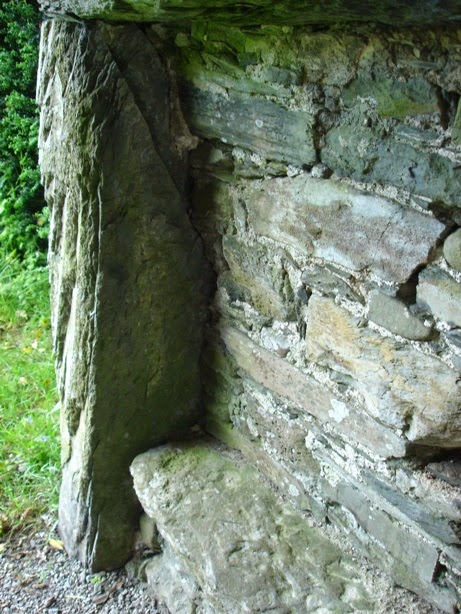
There, in a typically Welsh mediaeval church, you will find a shrine to a 7th century saint. Shrine, church and valley together make what the ancient Celts used to call a “thin place” – a place where it is easy to feel that two worlds meet.

This is an ancient place. The circular churchyard, its very shape a sign of its antiquity, lies over a Bronze Age burial ground, dating back to around 1200BC. It is enclosed by a ring of venerable yew trees, some of which have been estimated to be at least 2000 years old.


It was here, so tradition and legend tell us, that an Irish princess named Melangell came to live as a Christian hermit in the 7th century and here that she was found at prayer by Brochwel, Prince of Powys, when he was out hunting. The hare he was chasing took refuge under Melangell’s skirt and the hounds fled.


Brochwel, impressed by Melangell and her story, gave her the valley of Pennant, where she founded a small religious community and where, after many years as its abbess, she died and was buried. 

The valley was then named after her and the shrine of Pennant Melangell became a place of pilgrimage for centuries, until it was dismantled at the Reformation and its stones were built into the walls of the church and the lych-gate.


The present church building, though much restored over the years, dates back to the 12th century and at its heart is the reconstructed shrine, its stones retrieved from their centuries-long resting places and reassembled where they once stood. Today it is again a centre of pilgrimage, where people come to be quiet and apart in a place, where, as the poet T S Eliot put it, prayer has been valid.


I was there for a Mothers’ Union Quiet Day and in the silence I discovered again the timeless beauty of a place I first visited nearly twenty years ago. 


I wandered the narrow, flower-edged lanes, 


stood stock-still for ages in the church porch 
to watch a pair of swallows feeding their young 


imagined the pilgrims who had made their way here over the centuries


and sat quietly in the rebuilt mediaeval apse of the church, 
absorbed in the play of light and shade 
on the plain, white-washed stone walls,


 and acutely conscious of the atmosphere of prayer.


When we reluctantly had to leave, we drove home a different way, over the Berwyns, past Bala and its lake and back to our own bit of Mid-Wales, almost overwhelmed by the beauty and grandeur of the landscape of this little country in which we are fortunate enough to live. 


Monday, April 14, 2014

A touch of Tudor splendour

Given the slippery nature of time I shouldn’t be surprised to realise that it’s already more than two weeks since we arrived up here in the North-West Highlands after a most enjoyable 90th birthday celebration weekend for DH’s mother, which I haven’t even mentioned yet.

We assembled on the Friday afternoon at the home of DH’s youngest brother in Southport for an evening of family chatter before the big day itself. At 90 one doesn’t want to spend the day too strenuously before one’s birthday dinner in a local hotel, so it was decided we would go out in the afternoon for a gentle stroll around a local historic property, Rufford Old Hall, near Ormskirk.


Rufford Old Hall was owned by the Hesketh family for some 500 years until it was handed over to the tender care of the National Trust in 1936. The original building, which dates from around 1530, was a late mediaeval hall-house, though now only the Great Hall survives. Its elaborate and highly decorative half-timbering is both beautiful and impressive, though I couldn't help thinking how many oak trees it must have taken to build it.

Wonderfully carved screen 

Spartan dining

 Hammerbeam roof with angels - highly unusual outside a church

In 1661/2 a new wing was built at right angles to the original hall which, being brick-built in Jacobean style, contrasts very clearly with the hall’s black and white timbering. The house was further extended in the 1820s to give the building we see today


A touch of extra glamour is given to the house by the possibility that the young William Shakespeare himself may have acted in the Great Hall in the early 1580s when he was working as an assistant teacher in the household of a local landowner.

Detail of the screen

And this is meant to be movable?

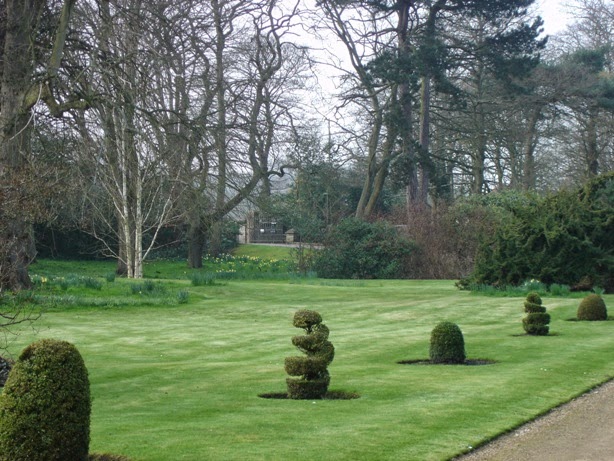
The house is surrounded on three sides by formal gardens and on the fourth by a branch of the Leeds to Liverpool canal, giving it an air of great tranquillity and timelessness and a feeling of being very far from the hustle and bustle of modern life. 


We thoroughly enjoyed our tour through four centuries of English domestic architecture and came home very ready to relax with tea and birthday cake before sprucing ourselves up for our evening out.

The doors would have given access to the lost wing

The photographer photographed - DH and his beloved camera

The birthday girl herself

Sadly, the sunshine we enjoyed that afternoon didn’t last and our journey up through Scotland on Mothering Sunday was notable for the mist and murk which conspired to hide even the grandest of the mountains we drove through. That’s Scottish weather for you!


Sunday, May 13, 2012

Journey through an ancient landscape

After the lovely sunset and afterglow of the previous evening, it was disappointing to wake up on my second day in Orkney to the sight of grey skies and rain-spattered windows. Nevertheless, trusting implicitly in the BBC weather forecast which had promised that conditions would improve, we had breakfast and set off to catch the mid-morning ferry across to Orkney Mainland. Thankfully the wind had dropped somewhat and the sea was much calmer than the day before, though it was still bitterly cold.

At the bus stop

Sian on her small island

Very soon we were in Stromness and setting off in Sian’s off-island car for our day’s exploration of a little of Orkney’s long history. As we drove the clouds started to disperse, the sun came out and before we knew it the sky was a glorious blue and the landscape breath-taking. Orkney is almost treeless and lacks the mountain grandeur of Sutherland, but the wide green sweep of its gentle hills and broad valleys, and the constant glimpses of water in loch and sea, give the soul room to breathe and I loved it.

When we arrived at our first destination, Scara BraeSian, who must know the introductory exhibition backwards after taking so many visitors there, left me to it and relaxed with a nice cup of tea. Meanwhile I was immediately fascinated by the informative and interactive way this marvellously preserved Neolithic village, a UNESCO World Heritage Site, was set in context for visitors before we actually saw it.

There is a walk of several hundred yards from the Visitors’ Centre to the village itself, and along its length markers commemorating important historical events have been placed in a kind of timeline to illustrate just how ancient this site is. Constructed and inhabited millennia before the birth of Christ, old and about to be abandoned when the first pyramids of Egypt were being built, the houses of Skara Brae, with their stone furniture and central hearths, give us a vivid and unforgettable glimpse into the lives of our distant ancestors.

The village by the sea
House and hearth
Stone furniture - dresser and beds by the walls
I said it was cold

When Neolithic farmers decided to settle at Skara Brae, the climate in Orkney was warmer and drier than it is today and the site they chose may have been on the shore of an inland loch. By the time the village was abandoned some six hundred years later, the climate had changed, becoming become colder and wetter and making cereal farming more difficult. This factor, combined with the gradual encroachment of the sea, may have contributed to the decision to leave, but no-one really knows why the inhabitants of this well-constructed village finally moved elsewhere.

Once abandoned the village gradually became covered by sand dunes until a great storm in 185o uncovered part of the remains, but it was many decades before they were properly excavated and conserved.

The land on which Skara Brae was discovered belonged to a local landowner who lived in the nearby Skaill House, acknowledged as Orkney’s finest large mansion. Very sensibly, Historic Scotland, which looks after Skara Brae and Skaill House, includes both on the same admission ticket, so after our visit to the remote past, we made our way back into relatively recent history by going round this interesting and appealing building, for so long an imposing but also intimate family home.

From Skaill House  Sian drove me to the other site I really wanted to see on my first visit: the great circle of standing stones known as the Ring of Brodgar. I have been familiar with the sight of the Ring since one of my sisters gave me a print of her pastel drawing of the monument some years ago, but to see it in all its remote and mysterious grandeur was still deeply impressive. 


The path up to it was slippery after the night’s rain and my balance is not of the best, but we made it up to the stones and walked much of the way round the huge circle in its wide and beautiful setting. The Ring of Brodgar is one of a number of ancient monuments which together make up the Heart of Neolithic Orkney World Heritage Site. It was probably constructed between 2500 and 2000 BC (after Skara Brae had been abandoned) and was the last of the great monuments to be built in this archaeologically rich area.

The intrepid duo - it was STILL cold
We only had time to visit two of these remarkable sites that day, but that leaves us plenty to see on a future visit. J After a late and leisurely lunch in Stromness I watched Sian catch the little ferry back to her small island before boarding my much bigger one for a calm and sunlit crossing back to Scrabster and DH at the end of my fascinating and memorable birthday trip. Here's to the next time....